- Polyethylene (PE) Granules27 products
- Polypropylene (PP) Granules10 products
- Polystyrene (PS) Granules4 products
- Polycarbonate (PC) Granules2 products
- Polymer Compounds3 products
- ABS Granules2 products
 Masterbatch1 product
- PET Resin (Bottle Grade)3 products
- Textile & Packaging Products1 product
- Rabin Recycled & Compound Granules4 products



PP sheet and thermoforming grades have the melt strength and impact resistance needed for extruded sheet, thermoformed cups and trays, and corrugated sheet.
• PP 440G – impact copolymer for extruded sheet and thermoformed packaging.
Need a price? Send the grade, quantity and destination via WhatsApp +98 912 640 4020 or our enquiry form – we usually reply within one business day.
In Karachi rate lists this type is quoted as Polypropylene Copolymer. PP 440G is prime, virgin copolymer dana in the producer’s bags, with the rate given CFR Karachi.
PP 440G – Sheet & Thermoforming Grade
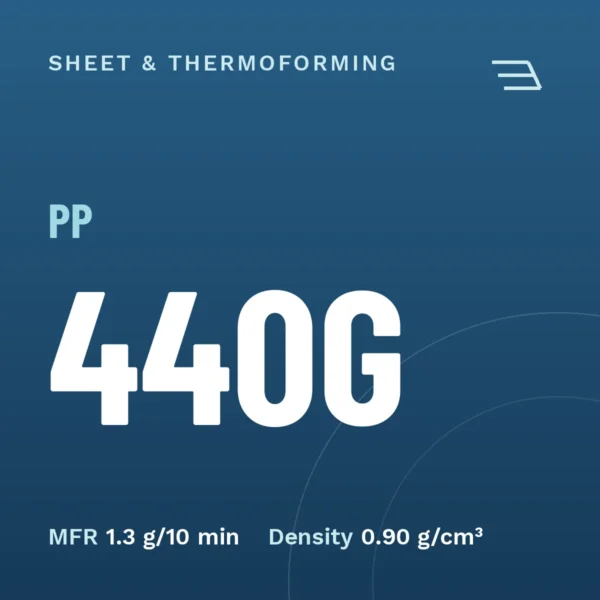
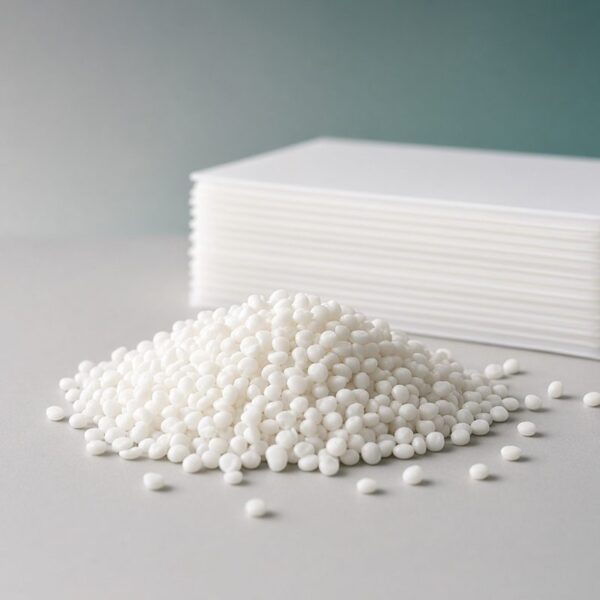
PP 440G is a nucleated heterophasic copolymer developed for sheet extrusion, thermoforming and corrugated board.
- MFR 1.3 g/10 min 230 °C / 2.16 kg
- Density 0.90 g/cm³
- Process Sheet Extrusion
PP sheet and thermoforming grade
Sheet grades are polypropylene impact copolymers with a low melt flow. The low flow gives the melt strength needed to extrude a flat, even sheet, and the copolymer structure keeps the sheet tough, even in cold weather. Typical products are corrugated PP board (flute board), stationery files and folders, thermoformed trays and boxes, and some blow-moulded containers.
| Grade | Melt flow | Density (g/cm³) | Best for | Datasheet |
|---|---|---|---|---|
| PP 440G | MFR 1.3 230 °C / 2.16 kg | 0.90 | Flute board, extruded sheet, trays | TDS PDF |
Why an impact copolymer for sheet
Homopolymer sheet is stiff but cracks when it is folded or dropped in winter. PP 440G has a notched Izod of about 500 J/m at 23 °C, so folded edges on files and boxes hold up and flute board survives handling on site. It also contains an antistatic additive, which helps keep dust off stationery and display products.
Running the line
- Melt temperature 200 to 240 °C. Keep the die lips clean to avoid lines on the sheet.
- For flute board, adjust vacuum sizing and haul-off speed together to keep the ribs straight.
- For thermoforming, heat the sheet evenly. PP has a narrow forming window compared with HIPS.
- Colour with a PP-carrier masterbatch; calcium carbonate filler can be added for stiffness if impact is not critical.
PP or HIPS for thermoformed packaging?
HIPS forms more easily and gives sharp detail, which is why dairy cups often use it. PP resists heat and oil better and can go in a microwave. If your product is hot-fill or microwaveable, choose PP. For yoghurt cups and display trays, compare with HIPS.
Where PP sheet goes
- Corrugated PP board for signage, packaging boxes and floor protection
- Stationery: files, folders and document cases
- Thermoformed trays and food containers
- Packaging separators and layer pads
- Some blow-moulded containers
Reading a sheet-grade datasheet
Look at melt flow (low, around 1.3 for sheet), notched Izod for impact, and flexural modulus for stiffness. For packaging that touches food, ask for the food-contact statement. For printed sheet, check how the surface takes ink after corona treatment.
Common sheet problems
- Die lines: clean the die lips and check for degraded material.
- Brittle folds in winter: use an impact copolymer, not homopolymer.
- Uneven thickness: check die heating zones and roll gap.
Ordering and delivery
Material leaves Iran in the producer’s original bags on pallets. Buyers in Pakistan can receive it by sea through Karachi or Port Qasim, or by road through Taftan. Route, packing and Incoterm are agreed order by order, because they depend on quantity, city and timing. Each shipment comes with a commercial invoice, packing list and certificate of origin.
For a rate, send the grade, the quantity and your city on WhatsApp or through the enquiry form. We reply within one business day.
Questions buyers ask
Can 440G be used for injection moulding?
It can, but its flow is low for most moulds. For injection parts, see the PP injection grades.
Can I add calcium carbonate to 440G?
Yes, for stiffer and cheaper sheet. Impact strength drops as filler goes up, so test with the product in use.


